Selected for AFI’26 by Crawford Art Gallery, Cork, Ireland.
What compels you to work with moving image, and when did you first become interested in the medium?
As an artist interested in the reimagination of realities and challenging canonical systems of belief and representation, moving image allows me to expand narratives beyond the static frame. In 2016, I began creating moving images to complete texts or poems and vice-versa; these texts always helped me to ground my still images. However, moving image allows me to capture the rhythm of ritual and the breath of spaces. By layering sound, movement, and time, I can create a more immersive subversion of traditional archives, sharing themes that are important to me through a shifting presence that refuses to be fixed or silenced.
This year’s theme, A Kind of Power, brings together films which explore the ethics of looking, watching and witnessing, in a world where images circulate instantly and visibility can both empower and endanger, how do you navigate the responsibility of looking -and of asking others to look –in your work?
I understand art as my kind of soft power, and I see each project as a vehicle—some are bicycles, others are cars, buses, boats, or submarines. For me, it is important as a conductor to voice the route of these vehicles and to make sure people on board understand where I took them by the end of the journey. Even if they don’t understand the trip straight away, I will share the map.
Images can imply multiple reflections that depend on the spectator’s life story, repertoire, and simple things such as their mood. I like to invite the spectator to share the ideas I’m conveying in that journey, so the act and the responsibility of looking are accompanied by words, some of which didn't even exist before. If a person can’t see what the images are saying, they will know what I want to express. This might be limiting to some artists, but for me it is important. Ensuring that the ideas I consider vital to the context are never left behind is directly linked to the ethics of making.
What new projects or lines of research are currently preoccupying you?
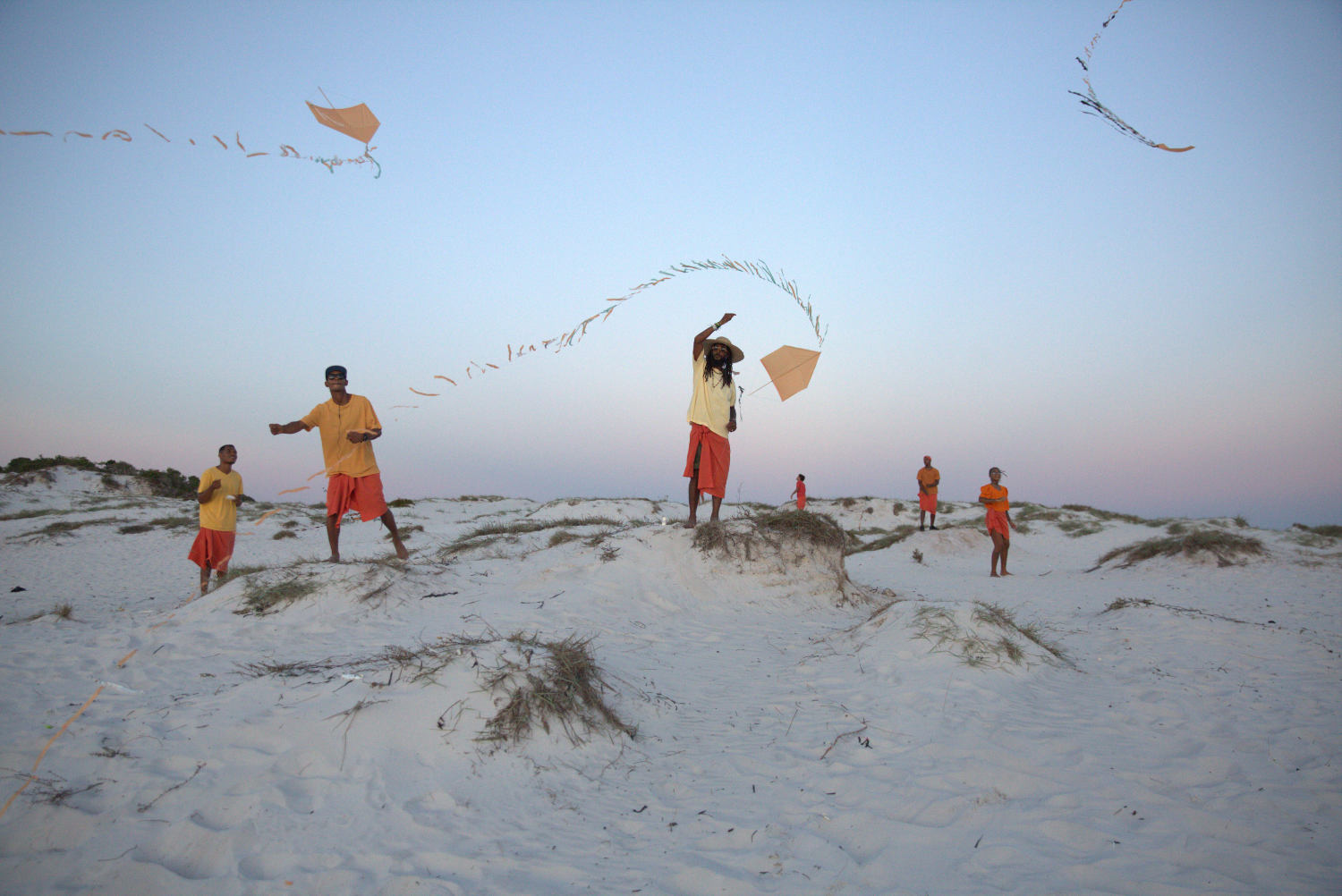
I have been devoted to a research project I call The New Atlantic Triangulations, of which The Kite Ballet is a part. Within this framework, I explore displacement, mental health, and joy through embodied cosmovisions and the mythologies of territories. These themes intersect with my own experience as a being of the transit, as someone who creates mechanisms of comfort and association between inherited and chosen identities, such as Bantu-Kongo, Irish, and Baiana, or Yorubaiana.
I reflect on mental well-being as a vital strategy to avoid being completely brutalized by Capitalism, techno-feudalism and so on. I am interested in sharing hacks about ways of living and Belief systems, especially with other beings of the transit. This includes the practice of flying kites, the importance of play as an adult, and the shift toward being less anthropocentric. My work reflects on degrowth and my own learning of stablishing non-extractive relationships with nature. This research is an umbrella that I have been keeping wide open to experiment with multiple mediums; I think the most exciting one is the creation of an orchestra.
Tháis Muniz's 'The Kite Ballet' is an eloquent, beguiling meditation on the power and necessary persistence of playful ritual and resistance. The film gently probes the general loss of play in adulthood yet the balletic movements of the kite flyers and the joy of these community activists show an alternative way of resisting capitalism’s unsustainable and indeterminate growth into natural habitats of indigenous people’s lands, which continues to threaten to displace and erode traditional communities in Salvador, Brazil. In its focus on the specific and local, the film speaks to wider geopolitical concerns and the need for deeper care within our communities.
Dawn Williams, Curator, Crawford Art Gallery, Cork

© 2026 www.crawfordartgallery.ie