Crawford Art Gallery is now closed for redevelopment.
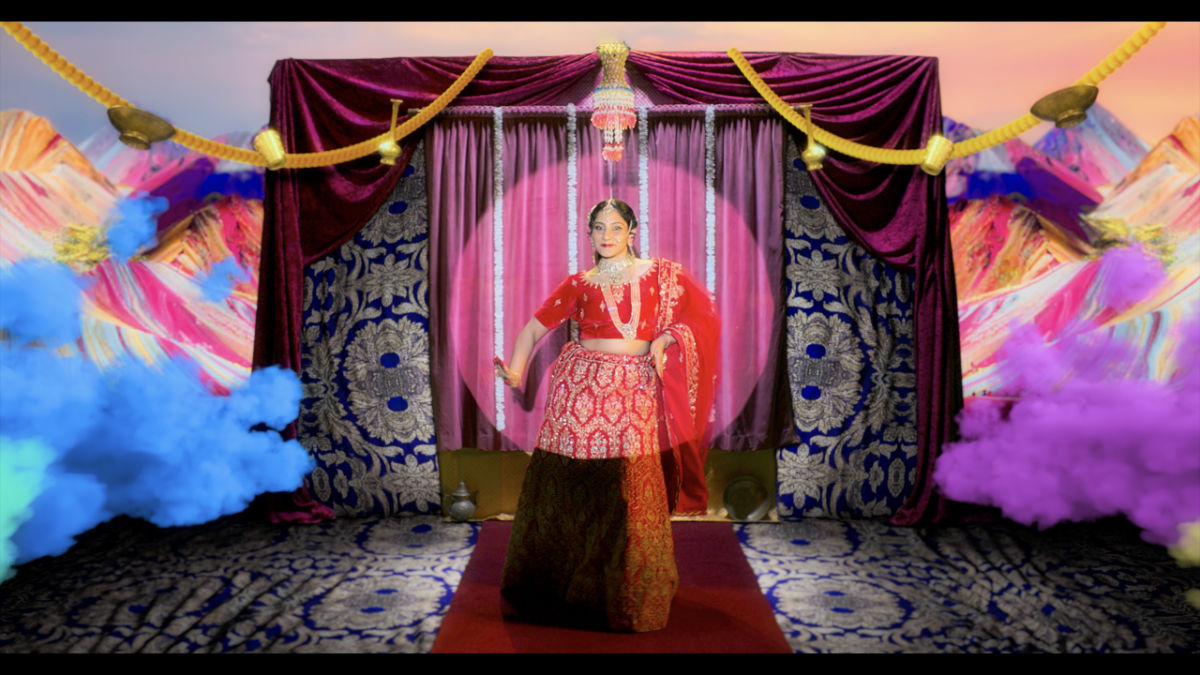
Colourful Indian scene
Aqsa Arif, Raindrops For Rani, 2025. Commissioned by Edinburgh Printmakers as part of Edinburgh Art Festival 2025 with funding from Creative Scotland. Courtesy of the Artist. Selected for AFI'26 by Tramway, Glasgow, Scotland

Aqsa Arif

Raindrops of Rani
(2025) 17:43 minuts

Selected by Tramway, Glasgow, Scotland
'Raindrops of Rani', draws on the tragic figure of Heer from the Punjabi love story Heer Ranjha. Arif reimagines her as Heera, a displaced mother navigating life in a Scottish high-rise flat with her young daughter after a flood destroys their home. Through this hybrid fantasy, Arif stages a layered narrative of a mother and daughter adapting differently and unequally to an environment marked by indifference and hostility. 

At its core lies the story of Arif’s own arrival in the UK from Pakistan. Her family was initially placed in a high-rise council flat in Prospecthill Circus, on Glasgow’s Southside. Years later, they were moved again by local authorities to facilitate the production of Sony Bravia’s 2006 Paint advert, an extravagant campaign requiring 1,500 explosive charges and 70,000 litres of paint. Directed by Jonathan Glazer with a reported budget of £2 million, the advert became an iconic spectacle. 

Meanwhile, the mostly working-class residents, refugees and asylum seekers, were displaced and rehoused in other Glasgow high-rises. Raindrops of Rani, reflects on the stark contrast between this global spectacle and the overlooked realities of the community it disrupted.
Tramway identity rev
Curatorial Text / Statement:

Along 'On the edge of the canvas' a woman’s body moves within the confines of stratified stone walls, spaces that evoke silence, isolation, and a concealed past. Her movement slips through layers of history, experiencing the memory of this place like a silent witness. Although her body appears small and vulnerable against these structures, her presence renders this history newly visible and tangible.

Her movement continues toward the refined stone stairways of a building that has repeatedly shifted its function over time, from a site of chemical production for war, to a military based, and eventually to a university and library. Its transformations narrate the persistence of power, power that changes form but does not disappear, power that survives by reshaping itself. Through her body, the woman draws the viewer into reading these layered narratives, urging us to consider what becomes visible and what remains hidden.

The woman’s body is simultaneously victim and narrator; it is both seen and seeing. The stone walls and the woman’s body, in their tension, arrive at a shared language. In the final moments of the film, the woman’s disappearance and the building’s continued presence before the lens reveal the culmination of this tension and its concealed dialogue, the erasure of the living body and the fixation of the stone archive. It is as if the moving narrative falls silent, and the stone wall, now the dominant memory, takes its place. What was once embodied and concrete becomes internal and abstract. This absence becomes the very sign of the narrative’s endurance.

Razieh Akbari has engaged with stone in her previous video works as well. In The Lost Bird, stone appears as a symbol of violence; in Hopscotch, she references a childhood game she once played. In Afghanistan, this game is common among young girls. In it, a girl’s mastery over her body and mind mirrors her mastery over the stone and its trajectory. She must learn this control through practice. The stone repeatedly strikes her foot until she acquires the skill to direct her movements precisely, ensuring the stone lands where it should. As Akbari notes, this game is endless.

Razieh Akbari is an emerging young artist working in the field of contemporary art and is currently continuing her studies at HfG Offenbach.

Tramway identity rev
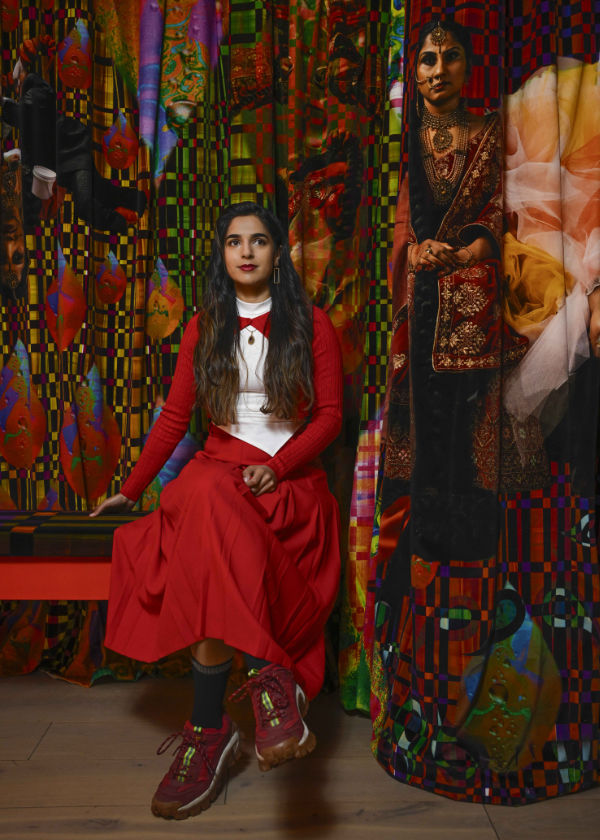
Photo of an artist
Photo: Neil Hanna
Artist Link
Aqsa Arif is a Scottish-Pakistani artist and filmmaker based in Glasgow. Her work has been exhibited across the UK, including at Edinburgh Printmakers, Kelvingrove Art Gallery and Museum, GoMA, Southwark Park Galleries, G39, and Site Gallery. She has undertaken residencies at Cove Park, Street Level Photoworks, Hospitalfield, Jupiter Artland, and The British School at Rome.

In 2022, she was awarded the 20/20 residency by UAL’s Decolonising Arts Institute, resulting in her first solo exhibition Anam Ki Almari (The Trophy Cupboard) and 20 permanent acquisitions across UK public collections. Her film Mountain of Light was acquired by Glasgow Museums and is now on permanent display at the Riverside Museum.

In 2023, Arif received the Platform: Early Career Artist Award and the RSA Morton Award, and was nominated for Jerwood Survey III, touring nationally from 2024–25. Her film Spicy Pink Tea was selected for BAFTA-qualifying festivals, winning Best Dance Film at Aesthetica and earning a nomination for Young Scottish Filmmaker at Glasgow Short Film Festival 2023. It toured nationally with Selected 13, curated by videoclub and FLAMIN, after a nomination by artists shortlisted for the 2022 Film London Jarman Award.
AFI Logo line
Crawford Art Gallery Logo web
HEAD OVER HEELS
WITH YOUR GALLERY.
Sign up to our newsletter

Pure Cork logo white
Ancient East logo white
Dept of Culture_Communications_Sport_Std_White

© 2026 www.crawfordartgallery.ie