Crawford Art Gallery is now closed for redevelopment.
Abstract Film still
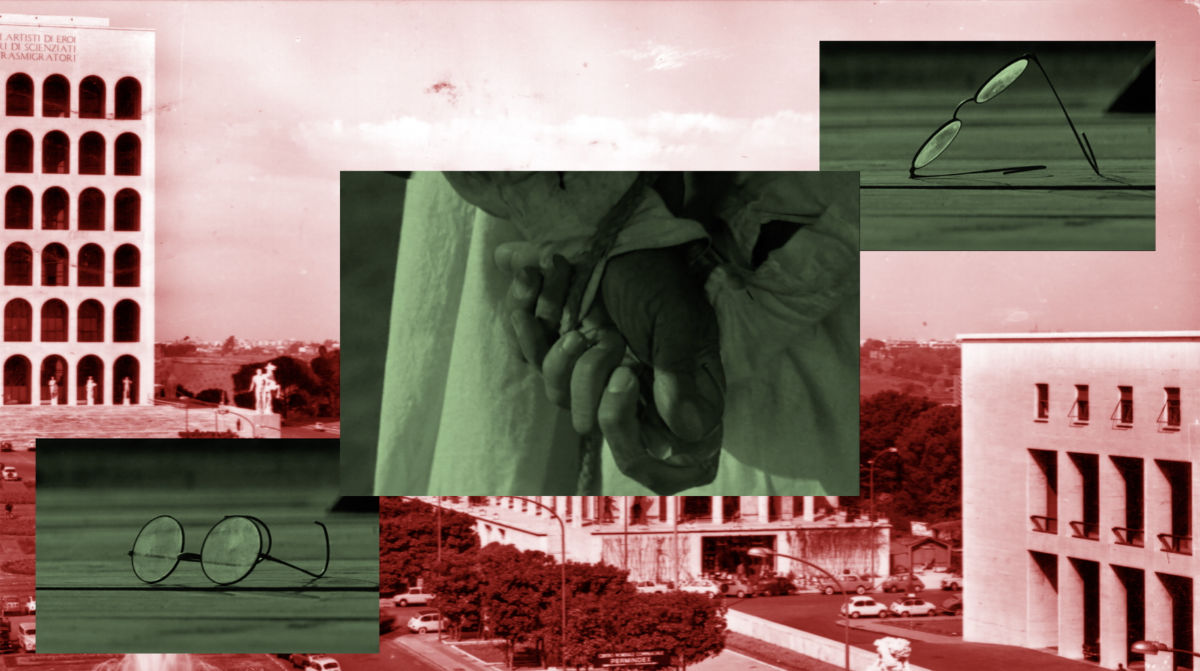
Alessandra Ferrini, Sight Unseen, 2019. Film Still. © and Courtesy the artist and Galleria d'Arte Moderna e Contemporanea di Bergamo.

Alessandra Ferrini

Sight Unseen
(2019) 18:54 minutes
Omar al-Mukhtar (1885-1931) was the leader of the resistance against the Italian occupation of Libya. He became the symbol of the Libyan people’s resilience and his legacy was exploited by the Gaddafi regime. 'Sight Unseen' explores the concealment and appropriation of the memory and documentation of Mukhtar’s final days: his capture, trial and spectacularised state killing. 

Based on visual and material culture that has been subject to either manipulation or obfuscation in Italy, the film focuses on the most complete series of images of Mukhtar's capture and execution, which at the time of filming was legally unpublishable. The voice and hands of historian Alessandro Volterra show and describe these images to the camera, although these are never fully revealed: barely discernible, they are faded to black, blurred, shown for just an instant.

Conveying the concealment and marginalisation of these images (and their legal ban), the film interweaves other documents and artefacts attesting to the carefully orchestrated politics of visibility and invisibility that shape the memory of colonial violence in Italy: Mukhtar’s contested glasses; the movie Lion of the Desert; extracts from Mukhtar's trial; and Monumento al Carabiniere, a 1933 memorial to the Italian armed forces in Turin.
Gamec logo
Curatorial Text / Statement:

We selected Alessandra Ferrini’s film 'Sight Unseen' because it addresses what we consider one of the most urgent questions in contemporary visual culture: the relationship between images, memory, and power. Through the figure of Omar al-Mukhtar, the leader of the anti-colonial resistance against the Italian occupation of Libya and a symbol of Libyan resilience, Ferrini brings to light the processes of concealment, appropriation, and erasure that have shaped the construction of Italy’s colonial memory.

At the centre of the film is the most complete photographic record of al-Mukhtar’s capture and execution in 1931. Although these images exist and are known to scholars, their publication remains legally restricted. Ferrini addresses this absence by interrogating the conditions that produce it, revealing how power operates not only through the production of images, but also through the regulation of their circulation, accessibility, and legibility.

'Sight Unseen' speaks directly to the theme of AFI 2026, A Kind of Power. The film invites us to reflect on who has the right to see, who can be represented, and under what conditions. More importantly, it asks what role photography can play within a culture of memory shaped by colonial legacies that, in Italy, have not been forgotten so much as left unnamed—histories for which we often lack either the language or the willingness to acknowledge their continued presence. 

What happens when an image is produced as an instrument of domination and propaganda? Is it possible to reactivate it critically without reproducing its violence? How do we engage with colonial images that continue to carry unsettling narratives and asymmetrical power relations?

Through strategies of partial revelation, omission, and narration, Ferrini turns these questions into the true subject of the film. Viewers are invited to interrogate the very mechanisms that have determined what can be seen and what must remain unseen.Looking thus becomes an exercise in critical responsibility. It is precisely this dimension that makes the film particularly meaningful for us, as curators at GAMeC. One of the central premises of Pedagogy of Hope, the museum’s 2026 programme inspired by the thought of Paulo Freire, is that education should provide the tools to read the world critically and to recognise the power structures that shape its representations. 'Sight Unseen' embodies this perspective by creating the conditions through which viewers can critically examine the mechanisms by which history is narrated, obscured, and forgotten.

Photo of a female artist with glasses
Photo: Alessandra Ferrini, 2025. Courtesy of the artist.
Artist Link
Alessandra Ferrini is an Italian-born, UK-based artist, researcher, and educator. Investigating the enduring legacies of Italian colonialism and Fascism within the Euro-Mediterranean area, her work is rooted in critical whiteness studies, radical historiography, archival and anticolonial praxis. Her practice spans across moving images, installation, and performance-lecture, as well as writing, publishing, and education.

Her work has featured in group shows and international film programmes, including: the 60th Venice Art Biennale Foreigners Everywhere (2024), the International Film Festival Rotterdam (IFFR 2025), De La Cruz Gallery (Washington DC, 2024), the 5th Casablanca Biennale (2022), Manifesta13 Paralléles du Sud (Marseille, 2020), Sharjah Film Platform (UAE, 2019), DEPO (Istanbul Biennal collateral, 2019), the 2nd Lagos Biennal (2019), Manifesta12 Film Programme (Palermo, 2018). Ferrini is the recipient of the Maxxi Bvlgari Prize 2022 and the 2017 Experimenta Pitch Award at the London Film Festival.

Solo exhibitions include: Fondazione Sandretto Re Rebaudengo (Turin, 2025), Museo Novecento (Florence, 2024), Ar/Ge Kunst (Bolzano, 2022), Villa Romana (Florence, 2019). Her first monograph, Like Swarming Maggots: Confronting the Archive of Coloniality across Italy and Libya (Archive Books, 2024) was supported by Villa Romana and the Italian Council (12th edition). She holds a PhD from the University of the Arts London.
AFI Logo line
Crawford Art Gallery Logo web
HEAD OVER HEELS
WITH YOUR GALLERY.
Sign up to our newsletter

Pure Cork logo white
Ancient East logo white
Dept of Culture_Communications_Sport_Std_White

© 2026 www.crawfordartgallery.ie